Weather, Soil & Structural Performance
Heavy rain. Extended dry periods. High winds. Coastal storms. Rapid changes between wet and dry conditions.
Weather has always affected the built environment. As property owners and builders experience changing weather patterns and significant storm events, it is worth understanding a simple engineering principle:
Your home or building doesn’t exist independently of the environment around it.
The structure, foundation, soils, groundwater, drainage, and surrounding property all interact. When conditions change, the performance of one can affect the others.
At Ingram Engineering Services, we help homeowners, builders, property managers, architects, and developers throughout Pennsylvania, Delaware, New Jersey, and Maryland evaluate those conditions and determine when an engineering solution may be necessary.
What Happens to Soil When Conditions Change?
A foundation relies on the soil beneath it for support. But soil conditions aren’t necessarily static.
Extended rainfall can increase soil moisture and groundwater levels. Concentrated stormwater can contribute to erosion or washout. Conversely, prolonged dry periods can cause certain soils to lose moisture and change volume.
The effect varies considerably depending on soil type, compaction, groundwater, drainage, foundation design, and other site-specific factors.
When movement occurs, engineers may evaluate the bearing capacity of the soils, differential settlement, subsurface conditions, and foundation performance to better understand what is happening.
That is why a crack in a foundation doesn’t automatically tell you what caused it.
A geotechnical investigation and structural evaluation can help determine whether an issue is associated with the structure, foundation, underlying soils, drainage conditions, or a combination of factors.
Heavy Rain Can Expose Existing Problems
A major rain event doesn’t necessarily create a structural problem overnight. Sometimes, it simply makes an existing weakness easier to see.
Poor drainage, deteriorating stormwater infrastructure, erosion, improperly compacted fill, or other site conditions may become more noticeable following significant rainfall.
Property owners might notice:
- New or expanding foundation cracks
- Water appearing where it hasn’t before
- Soil erosion or washout
- Settlement around foundations, patios, or other structures
- Changes in floors, walls, doors, or windows
- Depressions or possible sinkhole activity
- Movement around retaining walls
- Changes in drainage patterns around the property
These signs don’t necessarily mean there is a serious structural problem. They do mean further evaluation may be worthwhile, particularly when a condition is new or progressively getting worse.
When Soil Remediation Is Necessary
When testing determines that soils are contributing to settlement or foundation problems, there isn’t a single solution that applies to every property.
Depending on the conditions, engineers may recommend soil stabilization, foundation underpinning, removal and replacement of unsuitable material, drainage improvements, or compaction grouting.
Compaction grouting is a ground improvement technique in which a low-slump grout is injected into the subsurface to densify or stabilize surrounding soils. In the right application, it can be used to address loose or poorly compacted soils and improve support beneath existing foundations or proposed construction.
The important part comes before choosing the repair: determining why the movement is occurring.
Ingram’s geotechnical and structural capabilities allow our team to investigate the subsurface conditions and consider how they relate to the foundation and structure above.
High Winds Can Affect More Than the Roof
Major wind events introduce a different set of engineering concerns.
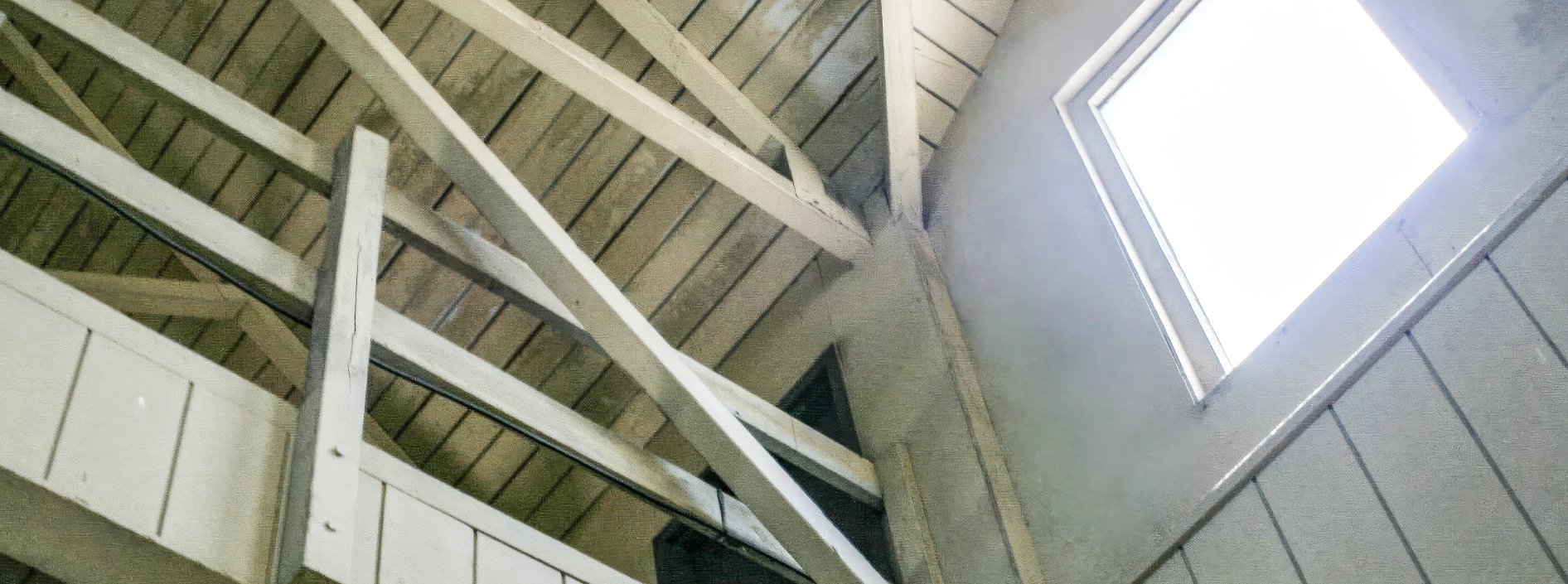
Roof systems transfer wind loads through trusses, rafters, bearing walls, connections, and ultimately into the foundation. Damage to one component can therefore require looking beyond the most obvious point of impact.
Following a significant storm, Ingram may perform a structural evaluation or roof truss analysis to assess damaged or questionable framing.
Roof truss analysis can be particularly important when trusses have been damaged by falling trees, wind, renovations, mechanical installations, or previous modifications. Engineers can evaluate the affected truss and its loading to determine whether repair, reinforcement, or replacement is appropriate.
The same principle applies to walls, beams, columns, connections, and other structural components.
Coastal Properties Bring Additional Considerations
For properties in coastal areas of Delaware, Maryland, and New Jersey, water, wind, groundwater, erosion, and soil conditions are familiar considerations.
Significant storms and changes in drainage can contribute to soil saturation, erosion, scour, or changes in subsurface conditions. Coastal properties may also be subjected to substantial wind loads that need to be considered as part of the structural system.
Understanding both the structure above the ground and the conditions supporting it is particularly important in these environments.
Because Ingram provides both structural and geotechnical engineering services, our team can evaluate the relationship between the building, foundation, and supporting soils rather than looking at each independently.
Don’t Assume. Evaluate.
A crack isn’t automatically a foundation failure.
A sticking door doesn’t necessarily mean your house is experiencing differential settlement.
A wet basement doesn’t automatically indicate a structural problem.
And one major storm doesn’t mean every property needs an engineering inspection.
The important part is recognizing when something has changed.
If cracks are appearing or growing, floors are moving, soil is eroding, a retaining wall has shifted, a foundation appears to be settling, or structural components have been damaged by a storm, getting a professional evaluation can provide clarity.
Early evaluation can also help identify manageable problems before they require significantly more expensive structural or geotechnical remediation.
Engineering for the Conditions That Actually Exist
Engineering begins with understanding the conditions in front of us.
Ingram Engineering provides structural engineering, geotechnical engineering, soil testing, site investigations, roof truss analysis, foundation evaluations, special inspections, construction materials testing, and laboratory testing to help property owners and project teams make informed decisions.
When remediation is necessary, solutions might include structural reinforcement, foundation repairs, drainage improvements, soil stabilization, or techniques such as compaction grouting.
Sometimes additional testing is needed.
And sometimes the engineering evaluation determines that the condition simply needs to be monitored.
The goal isn’t to make the problem bigger than it is. The goal is to understand it, identify the cause, and develop an appropriate solution.
Since 2007, Ingram Engineering Services has provided practical, economical, and responsive engineering solutions throughout Pennsylvania, Delaware, New Jersey, and Maryland.